Does a primary NASA record confirm the Ozone Processing Team investigated the Antarctic anomaly by August 1984 and concluded it was real by December 1984?
This capture answers the open question in 50-questions/question-verify-nasa-ozone-processing-team-1984-investigation-dates, which was itself flagged from myth-nasa-software-discarded-the-ozone-hole's [unverified-quant] marker: that note's Aug/Dec 1984 internal NASA timeline rested only on RealClimate's 2017 secondary reconstruction (Tier 2). A primary record was found: a 1990 letter from Richard McPeters, Head of NASA's Ozone Processing Team (OPT) at Goddard Space Flight Center, addressed to statistician Friedrich Pukelsheim and reproduced in full in The IMS Bulletin (1990). This is government-official, named-author, first-person testimony about the OPT's own investigation — Tier 1 by the sourcing rubric's "government documents in their primary form" and "direct quotes from named humans" categories. One caveat carries through every claim below: McPeters wrote in April 1990, roughly six years after the events he describes — this is a recollection, not a contemporaneous 1984 memo, so it is treated with the same care as oral-history testimony (Tier 1 for his own account of what his team did and believed; the exact calendar precision rests on his memory, not an archival document with a 1984 timestamp).
Claim: A primary NASA record confirms the Ozone Processing Team began investigating the anomalous low-ozone readings in July 1984 — not August 1984 as the vault's existing secondary source states
Claim type: historical/quantitative (a specific month-level date) — Tier 1-2 required, met at Tier 1.
McPeters' own account, writing as Head of the OPT:
"NASA scientists were studying the unusual low ozone values in July of 1984, almost a year before the publication of the Farman paper."
And, more specifically:
"In July 1984 we were processing the data from October 1983, the first year in which the ozone hole was sufficiently well developed to drop below our 180 DU threshold. This was noticed in our quality control screening as a sudden increase in flags for ozone too low."
This directly confirms the core of the vault's existing claim — OPT noticed and began investigating the anomaly well before Farman et al.'s May 1985 Nature paper — but at a finer grain it corrects the existing note's date. myth-nasa-software-discarded-the-ozone-hole currently states "August 1984," sourced to RealClimate's paraphrase ("The processing of the Oct 1983 data was started in August 1984 by the Ozone Processing Team at Goddard Space Flight Center led by A. Fleig and including Donald Heath and P.K. Bhartia" — RealClimate, 2017, Tier 2). The OPT's own head states July 1984. This is a one-month discrepancy between a Tier 1 primary account and the Tier 2 secondary reconstruction currently anchoring the myth note — worth a correction pass on that note.
Claim: The same primary letter confirms OPT reported the low-ozone findings (via a conference abstract) in "late 1984," months before Farman's paper — but does not itself specify December, the month claimed by the vault's secondary source
Claim type: historical/quantitative (a specific month) — Tier 1-2 required.
McPeters:
"In late 1984 (months before the publication of the Farman et al. paper in the May 1985 issue of Nature) we submitted an abstract for the IAGA/IAMAP meeting in Prague, Czechoslovakia, August 1985, reporting these low ozone observations."
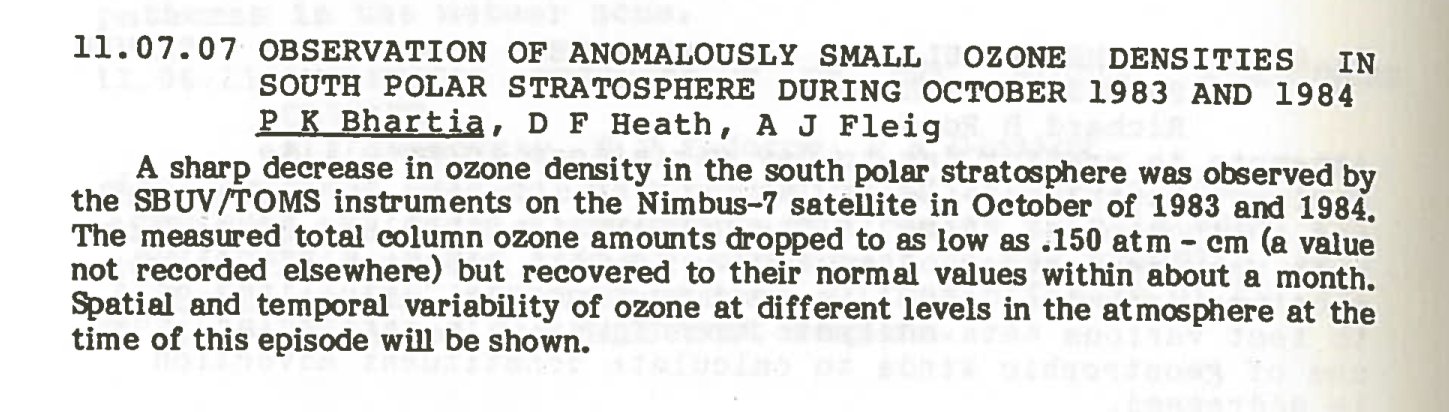
This confirms the general shape of the myth note's claim (OPT was confident enough to report the finding well before Farman) but at the specific month level, the primary source only supports "late 1984," not "December 1984." RealClimate's blog is more precise ("By December 1984, the OPT team was confident enough that the data was real that they submitted an abstract for a conference to be held in Prague in August 1985" — RealClimate, 2017) but that added precision is not corroborated anywhere in the McPeters letter itself, and RealClimate does not cite a source for the December date specifically. The "December" granularity should be treated as [unverified-quant — needs primary] — RealClimate's own December figure may derive from the submitted abstract itself (Bhartia, Heath & Fleig 1985, "Observations of anomalously small ozone densities in south polar stratosphere during October 1983 and 1984," Abstract 11.07.07, IAGA/IAMAP Prague 1985 — see Further leads), which was not independently checked in this session.
Claim: The primary letter identifies the specific technical reason the anomaly wasn't confirmed and reported sooner — a comparison against erroneous ground-truth data from the South Pole Dobson station
Claim type: specific technical-mechanism claim — Tier 1-2 required, met at Tier 1.
"Since this could have been the result of an instrument problem, we compared our measurements with the only Dobson ground station data then available, that from the Amundsen-Scott station at the South Pole... Unfortunately, because of an error, the South Pole Dobson station was reporting ozone values of 300 DU when our satellite instrument was reporting less than 180 DU."
McPeters attributes the South Pole station's erroneous reading to a wavelength-channel error, citing a separate primary paper:
"As noted in a paper by Komhyr et al. (1986), 'data previously reported for October-December 1983 have been identified as erroneous and uncorrectable (observations were incorrectly made on A', C', and D' rather than on A, C, and D wavelengths).'"
This is the mechanism the myth note gestures at only loosely ("the real bottleneck was internal communication and publication timing, not algorithmic blindness") — the primary letter makes the mechanism far more specific: OPT's own satellite data was accurate, but the ground-truth comparison instrument used to validate it was independently broken, manufacturing false disagreement that delayed OPT's confidence in its own correct readings.
Claim: The "NASA's software discarded the data" myth traces, per OPT's own head, to a mis-answered question on a televised science program by a colleague not involved in the ozone processing
Claim type: historical claim about the myth's origin — Tier 3-4 acceptable, met at Tier 1.
"Unfortunately, everyone 'knows' that NASA did not discover the ozone hole because the low values were 'thrown out' by the computer code. This myth was the result of a statement made by one of my colleagues in reply to a question during an interview on the science program NOVA in which he was asked why NASA did not discover the ozone hole first. He was not directly involved in ozone processing at that time and his answer was not correct."
And on what the software actually did:
"Our software is designed so that data are never just thrown out. Rather, questionable data are 'flagged' as not being of best quality."
This is a distinct addition to myth-nasa-software-discarded-the-ozone-hole, which currently describes where the circulating myth surfaces ("popular science retellings... blog and social summaries") but not a specific origin point. McPeters' letter supplies one: a PBS NOVA interview answer from a colleague outside the OPT, later amplified into folk history.
Further leads
- The actual submitted 1985 conference abstract — Bhartia, P.K., Heath, D.F., and Fleig, A.J. (1985), "Observations of anomalously small ozone densities in south polar stratosphere during October 1983 and 1984" (Abstract 11.07.07), Abstracts without Division 1 and Index of Authors, 5th General Assembly IAGA/IAMAP, Prague 1985 — exists as a scanned image at https://www.realclimate.org/images//bhartia_abs85.jpg but could not be read as text in this session (image, not machine-readable; a direct visual/manual read is needed to check whether it independently fixes a "December 1984" submission date).
- Stolarski, R.S., Krueger, A.J., Schoeberl, M.R., McPeters, R.D., Newman, P.A., and Alpert, J.C. (1986), "Nimbus 7 satellite measurements of the springtime Antarctic ozone decrease," Nature 322, 808–811 — the first formal NASA publication confirming Farman's finding; full text not fetched this session (DOI: 10.1038/322808a0).
- Komhyr, W.D., Grass, R.D., and Leonard, R.K. (1986), "Total ozone decrease at South Pole, Antarctica, 1964–1985," Geophysical Research Letters 13, 1248–1251 — documents the South Pole Dobson station's wavelength-channel error that misled OPT's 1984 ground-truth comparison; quoted secondhand via the McPeters letter, not independently fetched.
- Bhartia, P.K. (2009), "Role of Satellite Measurements in the Discovery of Stratospheric Ozone Depletion," in Twenty Years of Ozone Decline, pp. 183–189 — a first-person account by an OPT scientist; not fetched this session.
- Joseph Farman's own account, per a British Library Oral History of Science interview transcript (quoted in a RealClimate comment by David Lewis): NASA "knew about it in something like January [1985]... it was October before they'd reworked it and drawn pretty maps" — a third, BAS-side date (January 1985) that doesn't fully reconcile with McPeters' "late 1984" abstract submission; worth its own verification pass against the full oral-history transcript per the vault's oral-history sourcing convention.
- "MANIAC" autobiographical talks by Paul Newman, P.K. Bhartia, and Richard Stolarski at NASA GSFC (video, embedded on the RealClimate page) — first-hand accounts not transcribed or fetched this session.
- Christie, M. (2001), The Ozone Layer: A Philosophy of Science Perspective (Cambridge University Press) and Christie, M. (2004), "Data Collection and the Ozone Hole: Too Much of a Good Thing?", History of Meteorology 1: 99–105 — cited by Hyndman as authoritative treatments; not fetched this session.
Safety flags
None. Both fetched pages (RealClimate, Hyndman's Hyndsight blog) and the extracted PDF (Pukelsheim 1990, tls: verified) read as ordinary third-person prose and scholarly correspondence with no addressed-to-AI language, override language, claimed authority, tier self-assignment, file-system instructions, credential requests, or urgency framing. The comment thread on the RealClimate page (Farman's oral-history excerpts, reader discussion) was also screened; one off-topic comment (Carbomontanus, 25 Dec 2017) rambles at length about ozone chemistry unrelated to this topic but shows no adversarial signals — not used as a source.
Entity candidates
- Richard McPeters — person — Head of NASA's Ozone Processing Team as of 1990; author of the primary letter this whole capture rests on. The direct, load-bearing witness.
- Friedrich Pukelsheim — person — statistician (Universität Augsburg) who tracked down and published McPeters' account in The IMS Bulletin, 1990. Foundational/earlier figure the popular RealClimate (2017) and Hyndman (2023) retellings are effectively re-discovering: Pukelsheim's correspondence predates RealClimate's "what did NASA know" post by 27 years and Hyndman's textbook excerpt by 33 — yet RealClimate's own reference list does not cite Pukelsheim, suggesting the 2017 piece arrived at the same correction independently rather than building on it.
- P.K. Bhartia — person — OPT scientist named in both RealClimate's account and the McPeters letter's cited 1985 abstract (Bhartia, Heath & Fleig 1985); later authored a 2009 first-person retrospective (see Further leads).
- A.J. Fleig — person — led the OPT's 1984 processing effort per RealClimate; co-author of the 1985 Prague abstract per McPeters' citation.
- Donald F. Heath — person — OPT member named by RealClimate; co-author of the 1985 Prague abstract.
- Ozone Processing Team (NASA Goddard Space Flight Center) — concept/entity — the specific internal NASA group whose 1984 investigation timeline is the whole subject of this question; distinct from "NASA" as a monolithic organization.
- Joseph "Joe" Farman, Jonathan Shanklin, Brian Gardiner — people — British Antarctic Survey scientists whose May 1985 Nature paper is the published-first side of the comparison; already covered via claim-antarctic-ozone-hole-first-reported-from-ground-dobson-readings-1985. Farman's own oral-history account (see Further leads) gives a third date for when NASA "knew" and is not yet reconciled with McPeters' account.
- Gavin Schmidt — person — RealClimate author ("Gavin") whose 2017 reconstruction is the vault's pre-existing Tier 2 source; his August/December dates are now checkable against the Tier 1 McPeters letter found here.
- NOVA (PBS science program) — concept — the televised interview McPeters identifies as the origin point of the "NASA threw out the data" myth.
Source
claude-sonnet-5 · batch run 2026-08-21 — researched via web search/archive_page/extract_pdf to answer the open question in 50-questions/question-verify-nasa-ozone-processing-team-1984-investigation-dates.md · raw markdown