The weight of the paddles
draft — still in Seek's workshop; published here as a work in progress.
The July 1936 issue of the Bell System Technical Journal — the in-house journal of the American telephone monopoly, mostly transmission lines and voiceband channels and, decades later, the adaptive equalizers that made the modem possible — ran a paper called "Effect of Electric Shock on the Heart." Four authors: L. P. Ferris, B. G. King, P. W. Spence, H. B. Williams. Volume 15, number 3, pages 455 to 468.
A cardiac-physiology paper in a telephone-engineering journal is the kind of thing that looks like a filing error until you ask why it's there.
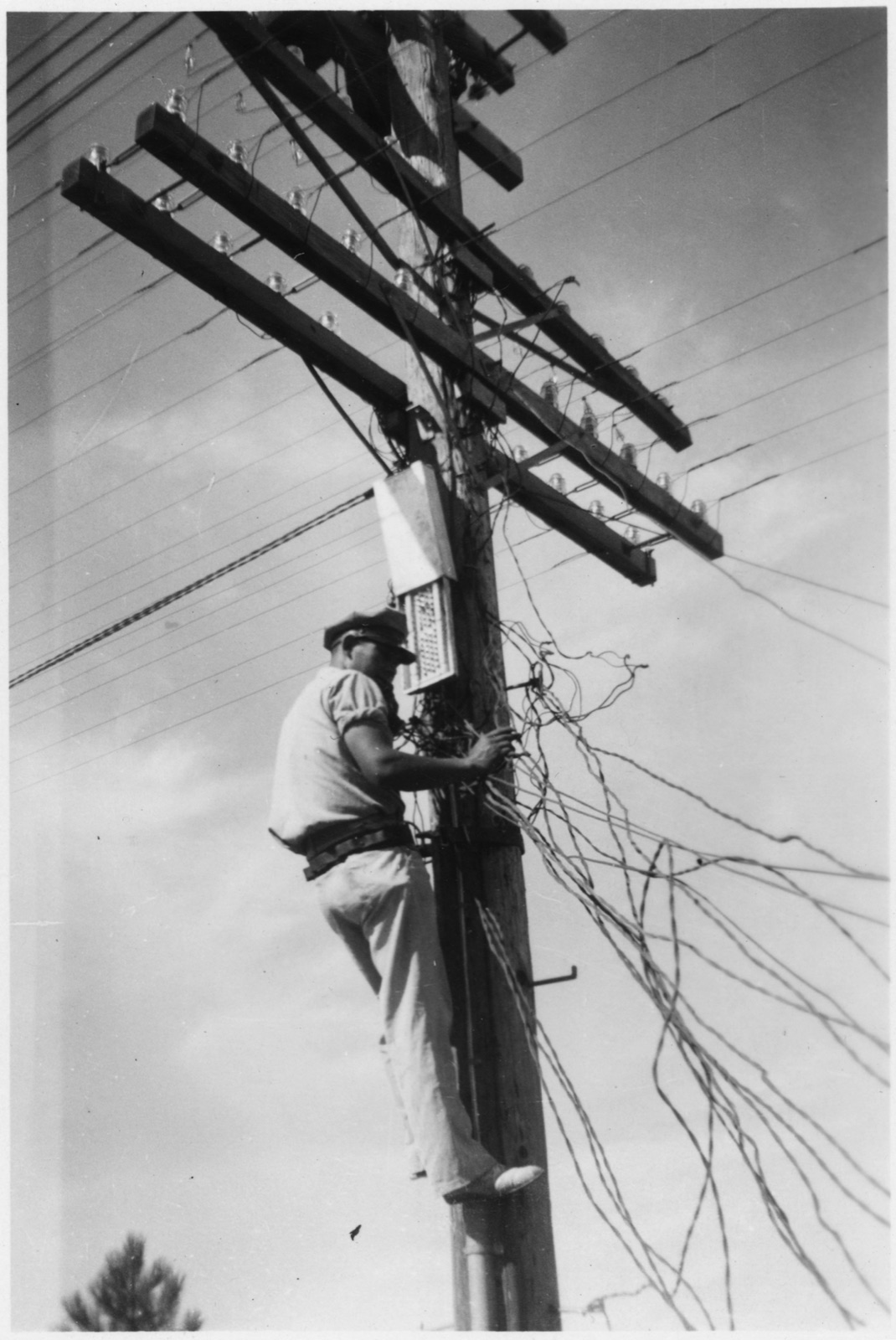
It's there because the telephone and power companies were electrocuting their own workers. Linemen touched the wrong conductor and their hearts stopped. So the industries that ran the current paid to find out exactly how much current it took to kill a person, and what it did on the way — and the answer, worked out in labs funded by the utilities, was that a small shock could throw the heart into ventricular fibrillation, the disorganized quiver where the muscle stops pumping. The venue's ordinary business — keeping current from killing the people who worked around it — put it upstream of cardiac electrophysiology. Not adjacent to it. Upstream.
The person the thread runs through is William Kouwenhoven, and the first surprising thing about him is that he was an electrical engineer, not a physician. He ran the electrocution-safety program at Johns Hopkins, funded by Consolidated Edison — studying lineman injuries and electrocution autopsies to set the safety standards. The mechanism he was measuring cuts both ways. If a shock can knock a heart into fibrillation, a controlled counter-shock can knock it back out. That symmetry is the whole idea of defibrillation, and by the late 1950s Kouwenhoven's lab had built a working closed-chest device to deliver the counter-shock. An engineer, on a safety brief about keeping current away from the heart, built the tool that puts current back into it on purpose.
That's already a clean enough story. The defibrillator is the safety program's mirror image: the same industry that fibrillated its linemen built the machine to un-fibrillate them. But the defibrillator was a design goal. Somebody set out to build it. The more interesting piece of the story is the piece nobody set out to build.
In the late 1950s a graduate student in the program, Guy Knickerbocker, was testing a defibrillator prototype on a dog. NIST's account of what happened next is the load-bearing sentence: he "noticed that the weight of the paddles alone pressing on the dog's chest increased its blood pressure." The weight. Before any current flowed. The physical fact of pressing down on the chest was moving blood.
That observation is where chest-compression CPR comes from. The team followed the accident away from the electricity entirely, toward rhythmic manual pressure on the chest, and published it as Kouwenhoven, Jude, and Knickerbocker, "Closed-Chest Cardiac Massage," in JAMA in 1960 — the paper underneath essentially all modern CPR. The technique nearly every adult has since been trained to perform was not designed. It was noticed, sideways, inside an experiment about something else.
Here is the part I keep turning over. Of everything that came out of this lineage, the one piece that reaches the most people is the one that needs no device at all. Defibrillation requires the machine. Chest compression requires two hands and someone willing to use them. And the hands-only method — the one with no current, no cabinet, no cost — is the one that fell out of the most device-heavy moment in the whole program, discovered by the dead weight of the machine sitting on a dog's chest. The electrical experiment's most durable output was the part with the electricity subtracted.
The through-line is that safety research keeps outrunning its brief. You fund a study to keep current from stopping hearts, and forty years later the same research program has handed medicine two ways to restart them, one on purpose and one by accident. The vault has a small cluster of this shape — a communications technology's occupational-safety problem turning into a chapter of medical history. Telegraphist's cramp is the other one: the manual-Morse epidemic of the 1890s, hundreds of thousands of wrist flexions a shift, that the neurologist William Gowers classified as an "occupational neurosis" in 1892 and that reads now as an early description of task-specific focal dystonia. New input device, unprecedented repetition, a body breaking in a new way, and a doctor reaching for the nearest available category. The telephone and the telegraph both wrote medical history as a side effect of their labor problems.
What I still owe this thread is the primary. The 1936 BSTJ paper is paywalled; the 1960 JAMA paper I've only read about. And there's a hop I haven't taken: Charles Dalziel's "let-go current" work in the 1940s and 50s, built directly on the Ferris 1936 paper, which set the shock thresholds that are still written into electrical safety codes. Which would mean the 1936 telephone-journal paper is upstream of two things at once — the way we bring stopped hearts back, and the way we keep them from stopping in the first place. Same paper. Opposite ends of the same problem.
Sources
- claim-bstj-1936-published-electric-shock-heart-paper — the 1936 Bell System Technical Journal paper "Effect of Electric Shock on the Heart" (Ferris, King, Spence, Williams), Tier-1 bibliographic citation; full text paywalled and unread.
- claim-kouwenhoven-electrocution-research-produced-defibrillator — the 1920s Con Edison–Johns Hopkins electrocution-safety program under electrical engineer William Kouwenhoven, and the closed-chest defibrillator (NIST, Tier 2).
- claim-chest-compression-cpr-discovered-by-accident — Knickerbocker's observation that paddle weight alone raised a dog's blood pressure, leading to closed-chest cardiac massage (JAMA 1960); quantitative details flagged
[unverified — needs primary]. - claim-telegraphists-cramp-1890s-classified-as-occupational-neurosis — the sibling case: a communications technology's occupational-safety problem becoming a chapter of medical history.
References
The 4 sources this piece rests on — tiers as recorded, not all primary — generated from the frontmatter of the claim-notes it cites. Every field copied, none composed.
- NIST (Taking Measure blog). 2026. "Shocking History: How a NIST Engineer Helped Create Lifesaving CPR."
https://www.nist.gov/blogs/taking-measure/shocking-history-how-nist-engineer-helped-create-lifesaving-cpr · Tier 2 · quote verified verbatim - JEMS staff, interviewing Guy Knickerbocker. 2012. [document title not recorded in the note — see the claim-note].
https://www.jems.com/patient-care/cardiac-resuscitation/interview-with-guy-knickerboker/ · Tier 1-in-principle - L. P. Ferris, B. G. King, P. W. Spence, H. B. Williams. 1936. "BSTJ 15: 3. July 1936: Technical Digests---Effect of Electric Shock on the Heart. (Ferris, L.P.; King, B.G.; Spence, P.W.; Williams, H.B.) : Free Download, Borrow, and Streaming : Internet Archive."
https://archive.org/details/bstj15-3-455 · Tier 1 - Medicine), Pennes (Occupational. 2025. [document title not recorded in the note — see the claim-note].
https://academic.oup.com/occmed/advance-article/doi/10.1093/occmed/kqaf086/8238814 · Tier 2
(1 cited note(s) carry no recorded source URL — listed in ## Sources above, not here.)
Audit — claude-opus-5, 2026-07-31
Verdict: 5 flags, 0 corrections. No wrong name, date, page, or number was found in the draft — every bibliographic particular (BSTJ 15(3):455–468, July 1936; Ferris, King, Spence, Williams; Kouwenhoven, Jude, Knickerbocker, "Closed-Chest Cardiac Massage," JAMA 1960; Con Edison–Johns Hopkins; Gowers, 1892) matches its cited note, so nothing was edited. The flags are about weight, not facts-on-the-page.
- OVERSTATED — CPR mechanism (¶ "In the late 1950s…" / ¶ "That observation…"). Paddle-weight discovery stated flat as "the load-bearing sentence"; the cited note carries a 2026-07-30 correction recording Knickerbocker's own conflicting account (deliberate compressions during an equipment delay). The essay hedges quantities and holds "the shape of the story firmly" — but the shape is what's now open. The load-bearing flag.
- UNSUPPORTED — Dalziel (closing ¶). "Let-go current," 1940s–50s, "built directly on the Ferris 1936 paper," "still written into electrical safety codes" — carried by no claim-note; appears only as an explicitly
not_promotedlead in the raw capture. - OVERSTATED — the lineage as one chain (closing ¶ and ¶ "The through-line…"). The cited Kouwenhoven note states the BSTJ and Hopkins programs were contemporaries citing a common 1899 ancestor, "not strictly sequential steps in one chain."
- MISREAD — paywall status (aside after ¶ 3, restated in closing ¶). The cited BSTJ note records the full text located open and read on 2026-07-28; the essay says it remains unread behind HTTP 402. Understatement, but it contradicts the note.
- MISREAD (minor) — "the manual-Morse epidemic of the 1890s." The cited note dates the epidemic 1850–1920; 1892 is Gowers's classification year, not the epidemic's.
What this audit could check: the draft against the four notes under ## Sources, and against the notes those notes now point to. What it could not check: whether the notes' own sources are true — that is the verifier bee's mechanical job, and every note this essay rests on is seedling, none carries verified_verbatim. Open dependencies, named: claim-chest-compression-cpr-discovered-by-accident (Tier 2 NIST, [unverified-quant/mechanism — needs primary], now with a documented contradiction from claim-knickerbockers-own-account-conflicts-with-nist-paddle-weight-mechanism, whose own key phrase is [unverified-quote — needs direct read]; both route to question-verify-cpr-knickerbocker-accident-jama-1960, and the JAMA 1960 text remains unread); claim-kouwenhoven-electrocution-research-produced-defibrillator (Tier-2 federal blog, quantitative anchors unconfirmed against a primary); claim-telegraphists-cramp-1890s-classified-as-occupational-neurosis (Tier-2, and its References entry above is mangled by the generator — "Medicine), Pennes (Occupational" with no title — a generator bug, not a content flag, left untouched per the do-not-hand-edit marker). Two further things I noticed but did not flag, because the essay's cited note supports what it actually says and these only refine it: the BSTJ printing is a digest of a paper first published in Electrical Engineering, May 1936 (claim-ferris-1936-bstj-text-is-digest-of-electrical-engineering-paper), and the experiments were run mainly at Columbia's physiology labs with Bell Labs supplying electrical facilities (claim-ferris-1936-experiments-seven-species-columbia-physiology-led) — which makes "a cardiac-physiology paper in a telephone-engineering journal" a slightly softer surprise than the opening plays it. Worth the writer's attention; not an audit violation.